 IND
IND AUS
AUS UAE
UAE USA
USA
Acquisition Advisory Services for Investors & Buyers in Singapore
Singapore has established itself as a central hub for cross-border acquisitions across Asia-Pacific, particularly for investors, family offices, and multinational groups seeking structured expansion.
However, executing a successful acquisition in this environment requires more than access to opportunities – it requires rigorous evaluation, disciplined structuring, and a clear understanding of downside exposure.
Acquisition decisions often involve significant capital commitments, multi-jurisdictional considerations, and long-term strategic implications. A structured advisory approach ensures that each stage – from opportunity assessment to transaction execution – is aligned with both financial objectives and risk tolerance.
Our role as a Buy-side Mergers and Acquisitions (“M&A”) Advisor for Singaporecompanies is to support buyers through this process with a focus on in-depth due diligence, risk assessment and legal structuring.
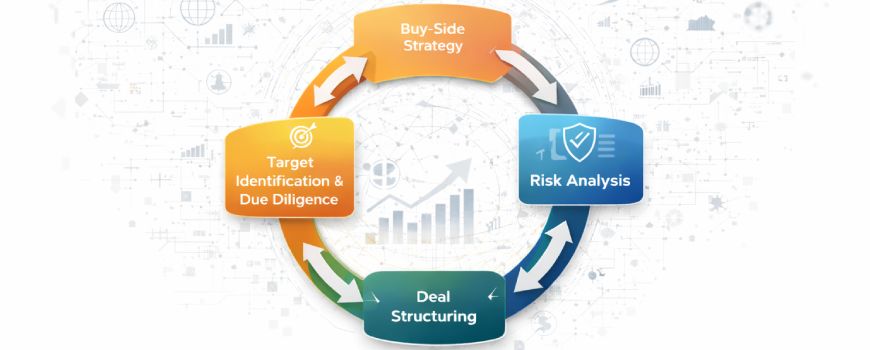
Acquisition advisory for buyers involves managing and advising on the entire transaction lifecycle, including:
- Defining acquisition strategy and investment criteria
- Identifying and evaluating potential targets
- Conducting detailed financial, tax, and operational due diligence
- Structuring transactions to align risk and return
- Supporting negotiations and transaction closure
A well-executed advisory process ensures that acquisition decisions are based on verified financial performance, realistic projections, and clearly understood risks, rather than headline metrics or seller representations.
As an M&A advisory firm in Singapore for buyers, the focus is on ensuring that capital is deployed into opportunities that are commercially viable, structurally sound, and aligned with long-term objectives.
Buy-Side M&A Strategy
Effective acquisition strategies are defined by precision in selection, not volume of opportunities.
A disciplined approach involves:
- Clearly defined investment parameters across sector, deal size, and return thresholds
- Evaluating acquisition-led expansion against organic growth alternatives
- Identifying transactions with tangible post-acquisition value creation potential
- Ensuring alignment between capital deployment and long-term strategic positioning
In practice, the majority of value is created by eliminating misaligned opportunities early, ensuring that only transactions meeting strict financial and strategic criteria progress further.
As an acquisition advisor in Singapore for investors, the focus remains on ensuring that each opportunity is backed by a clear, defensible investment thesis – not momentum or market noise.
Target Evaluation & Due Diligence
At the mid-to-upper market level, deal access is rarely the constraint. The real differentiator lies in the ability to assess earnings quality, validate sustainability, and uncover underlying risks with accuracy.
- Financial Analysis
- Validation of revenue quality and repeatability
- Assessment of margin durability and cost structure integrity
- Normalization of working capital requirements
- Identification of non-recurring, inflated, or timing-driven income
- Commercial & Operational Review
- Customer concentration and revenue dependency exposure
- Operational scalability and execution capability
- Supplier reliance and continuity risk
- Management depth and transition feasibility
- Tax & Structural Considerations
- Identification of existing tax exposures and contingent liabilities
- Cross-border implications impacting transaction efficiency
- Structural effectiveness of the target’s current setup
Among established mergers & acquisition advisory firms in Singapore, the depth of diligence directly translates into valuation discipline and negotiation leverage.
Deal Structuring
Transaction outcomes are shaped less by headline pricing and more by how diligently the deal is structured.
Key structuring considerations include:
- Aligning consideration with actual performance delivery
- Balancing upfront capital deployment with deferred components
- Designing earn-outs linked to clearly measurable financial metrics
- Optimizing jurisdictional positioning for tax and capital efficiency
Well-structured transactions ensure that risk is proportionately allocated while preserving upside potential, particularly in scenarios with limited forward visibility.
Risk Analysis
Every acquisition carries inherent uncertainty. The objective is not to eliminate risk, but to ensure it is identified early, quantified rigorously, and embedded into transaction terms.
Core areas of analysis include:
- Operational exposure risks
- Asset risks
- Financial risks
- Liquidity risks
- Tax risks
- Reporting and accounting risks
- Consistency risks
- Regulatory risks
- Company specific risks
- Other sector specific risks
This approach enables buyers to evaluate opportunities based on risk-adjusted returns, rather than relying on headline valuation metrics or seller projections.
Structured Buy – Side Advisory vs Conventional Approach
| Aspect | Structured Buy-Side Advisory Approach | Conventional / Broker-Led Approach |
|---|---|---|
| Target Evaluation | Deep financial and commercial analysis | Surface-level financial review |
| Earnings Assessment | Normalized EBITDA with adjustments | Reliance on reported numbers |
| Risk Identification | Quantified and factored into valuation | Often identified late or ignored |
| Deal Structuring | Performance-linked, risk-aligned | Fixed price, limited flexibility |
| Negotiation Leverage | Data-backed adjustments and insights | Price-driven negotiation |
| Capital Protection | Downside mitigated through structuring | Higher upfront exposure |
| Cross-Border Considerations | Integrated tax and jurisdictional planning | Minimal structuring focus |
| Outcome Quality | Risk-adjusted returns and stability | Higher risk of overpayment |
Why Choose Anbac Advisors?
Transaction experience includes advising on multi-million dollar acquisitions, often within the SGD 5 million to SGD 900 million range, where structuring, diligence depth, and capital protection are critical.
The approach is anchored in ensuring that every deployment of capital is supported by defensible valuation and clearly defined risk parameters.
- Strong emphasis on financial diligence and deal structuring
- Experience across cross-border transactions using Singapore as a base
- Integrated perspective covering financial, tax, and commercial considerations
- Focus on clarity, analytical depth, and execution rigor
As a M&A advisory firm Singapore for buyers, the objective is to support well-informed acquisition decisions and disciplined execution.
Case Study
- Earnings Quality Review & Valuation RecalibrationA Singapore-based target presented strong top-line growth with stable margins.A detailed earnings review identified a material portion of revenue linked to non-recurring contracts and timing-based recognition, overstating sustainable EBITDA.Further analysis highlighted:
- Revenue concentration across a limited client base
- Working capital adjustments impacting real cash flows
- Margin distortion due to one-off cost deferrals
Outcome:
Valuation was recalibrated to reflect normalized earnings, resulting in improved pricing discipline and stronger alignment with underlying business performance.
- Transaction Structuring for Downside ProtectionAn investor-led acquisition involved a target with growth potential but limited visibility on future earnings consistency.Instead of relying on a fixed upfront valuation, the transaction was restructured to include:
- Deferred consideration linked to performance milestones
- Earn-out mechanisms aligned with revenue and EBITDA thresholds
- Risk allocation across seller and buyer based on actual outcomes
Outcome:
- Reduced upfront capital exposure
- Alignment between payment and performance delivery
- Improved downside protection without compromising upside participation
FAQs
- What does buy-side acquisition advisory in Singapore typically involve?
Buy-side acquisition advisory is centered on evaluating the quality of a transaction before capital is committed. This includes validating earnings, assessing commercial sustainability, identifying financial and structural risks, and structuring transactions to align price with actual performance. The objective is to ensure that the acquisition is defensible from both a valuation and risk perspective.
- Why engage an acquisition consultant in Singapore as an investor?
Acquisitions often appear attractive at a headline level but require deeper scrutiny. An experienced acquisition consultant Singapore for investors brings independent financial analysis, risk identification, and structuring capability, ensuring that decisions are based on underlying business fundamentals rather than seller positioning.
- How do leading M&A advisory firms in Singapore differentiate on buy-side mandates?
Among established mergers acquisition advisory Singapore firms, differentiation is driven by:- Depth of financial diligence (beyond reported numbers)
- Ability to quantify risks and reflect them in valuation
- Structuring transactions to align risk and return
- Translating analysis into negotiation leverage
The outcome is not just deal completion, but improved deal quality.
- Do you support cross-border acquisitions through Singapore structures?
Yes. Singapore is frequently used as a holding and structuring jurisdiction for regional and international acquisitions. Advisory typically incorporates cross-border tax considerations, regulatory factors, and capital structuring, ensuring efficiency across jurisdictions.
- At what stage should acquisition advisory be engaged?
Ideally, the advisor should be engaged before commercial terms are finalized. The most critical value is created during the evaluation and structuring phase, where assumptions can be tested, risks identified, and pricing aligned with underlying performance.
- How does deal structuring impact overall returns?
Deal structuring directly influences both capital exposure and return outcomes. Elements such as deferred consideration, earn-outs, and performance-linked payouts can significantly improve alignment between price and performance, while reducing downside risk in uncertain scenarios.
- What are the most common risks identified during acquisitions?
Typical risks include:- Overstated or non-recurring revenue
- Margin distortion due to timing or accounting practices
- Customer or supplier concentration
- Working capital gaps impacting cash flow
- Undisclosed liabilities or tax exposures
Identifying and quantifying these risks early allows them to be factored into valuation and deal terms.
Considering an Acquisition in Singapore?
Overstated earnings, hidden liabilities, and poorly structured deals often become visible only after capital is deployed. Early evaluation ensures risks are identified before they impact valuation or returns.
Contact our team of experts at Anbac Advisors at office@anbacadvisors.com.