 IND
IND AUS
AUS UAE
UAE USA
USA
Transfer Pricing Advisory in Singapore for Multinational Companies
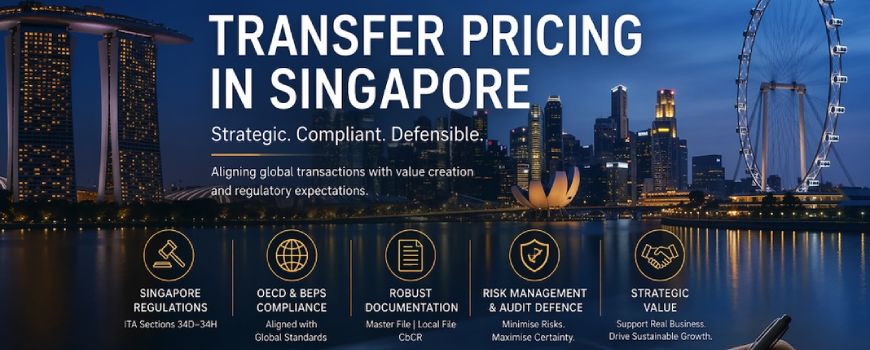
Introduction: Strategic Importance of Transfer Pricing
In today’s interconnected global economy, multinational enterprises (MNEs) operate through complex cross-border structures involving multiple group entities. These entities engage in intercompany transactions—ranging from provision of services and sale of goods to licensing of intellectual property and intercompany financing—which directly influence how profits are allocated across jurisdictions.
For companies operating in Singapore, transfer pricing (TP) is no longer a routine compliance requirement. It has evolved into a strategic and high-risk area, where businesses must ensure that their intercompany pricing reflects commercial reality, aligns with value creation, and withstands increasing scrutiny from tax authorities. An experienced transfer pricing consultant in Singapore can help multinational companies follow all requirements as per law.
With growing global focus on transparency and profit allocation, businesses must adopt a proactive transfer pricing strategy that integrates legal compliance, operational alignment, and audit defensibility.
Transfer Pricing Regulations in Singapore: Legal
Singapore’s transfer pricing framework is governed by the Income Tax Act 1947 and administered by the Inland Revenue Authority of Singapore (IRAS). The regime is closely aligned with OECD transfer pricing guidelines and the Base Erosion and Profit Shifting (BEPS) framework.
Over the years, Singapore has transitioned from a documentation-driven regime to a risk-based enforcement model, where IRAS actively reviews and challenges cross-border transactions.
Key Legal Provisions under Singapore Transfer Pricing Regulations
- Section 34D – Arm’s Length Principle
Section 34D forms the foundation of Singapore’s transfer pricing regime. It empowers IRAS to adjust related-party transactions that are not conducted at arm’s length.
- Applies to all intercompany transactions
- Allows profit reallocation across jurisdictions
- Focuses on alignment of profits with economic substance
Insight:
This provision is actively enforced—making it critical for businesses to ensure that pricing structures are commercially justifiable and defensible.
- Section 34E – Transfer Pricing Documentation
Section 34E mandates contemporaneous transfer pricing documentation for companies meeting prescribed thresholds.
- Documentation must be prepared in real time
- Includes FAR analysis, benchmarking, and financial data
- Must be submitted upon IRAS request
Key Risk:
Inadequate or inconsistent documentation is one of the primary triggers for transfer pricing audits in Singapore.
- Section 34F – Corresponding Adjustments
This provision helps eliminate double taxation by allowing corresponding adjustments when another jurisdiction makes a transfer pricing correction.
- Section 34G – Advance Pricing Arrangements (APA)
APAs provide certainty by allowing companies to agree on pricing methodologies with IRAS in advance.
- Reduces audit risk
- Suitable for complex or high-value transactions
- Section 34H – Surcharge on TP Adjustments
- 5% surcharge on transfer pricing adjustments
- Applies regardless of intent
Strategic Implication:
Even unintentional mispricing can result in significant financial exposure.
Singapore Transfer Pricing Regulations vs OECD Framework
| Aspect | Singapore TP Regulations | OECD Guidelines |
|---|---|---|
| Legal Basis | Income Tax Act (Sections 34D–34H) | OECD Model Tax Convention (Article 9) |
| Documentation | Mandatory under Section 34E | Master File, Local File, CbCR |
| Enforcement | IRAS-led audits | Multi-jurisdictional audits |
| Focus | Compliance + enforcement | Global consistency |
| Risk Trigger | High-value transactions, weak documentation | Profit shifting, lack of substance |
Regulatory Trends in Singapore
IRAS has increased scrutiny on:
- Regional headquarters structures
- Intercompany service arrangements
- Intellectual property transactions
- Intercompany financing
Conclusion:
Transfer pricing in Singapore is now a core risk area, requiring strategic planning rather than reactive compliance and a cross border transfer pricing expert in Singapore understands the risks and helps MNC’s to resolve them through various strategies.
OECD Transfer Pricing Guidelines and Global Regulatory Framework
The OECD Transfer Pricing Guidelines form the global benchmark for transfer pricing compliance and are adopted by most major jurisdictions, including Singapore.
With the introduction of the BEPS framework, transfer pricing has become central to global tax enforcement.
- Core OECD Transfer Pricing Principles
- Arm’s Length Principle (Article 9)
- Ensures transactions reflect market conditions
- Allows tax authorities to adjust profits
- Functional Analysis (FAR Analysis)
Evaluates:
- Functions performed
- Assets utilized
- Risks assumed
Insight:
FAR analysis determines where profits should be allocated, not where companies prefer them to be booked.
- Comparability Analysis
- Benchmarking against independent companies
- Selection of appropriate pricing methods
Common Issue:
Weak benchmarking significantly increases audit risk.
- OECD BEPS Framework (Critical for MNCs)
BEPS Actions 8–10 require that profits are aligned with actual value creation, preventing artificial profit shifting across jurisdictions. Complementing this, BEPS Action 13 introduced a three-tier documentation framework—Master File, Local File, and Country-by-Country Reporting which enhances transparency and enables tax authorities to assess global profit allocation and transfer pricing risks.
BEPS Actions 8–10
- Align profits with value creation
- Prevent artificial profit shifting
BEPS Action 13 – Documentation
Introduces:
- Master File
- Local File
- Country-by-Country Reporting (CbCR)
Global Enforcement Landscape
Tax authorities today:
- Share information across jurisdictions
- Conduct joint audits
- Challenge inconsistencies aggressively
Key Insight:
Transfer pricing is no longer reviewed at a country level—it is assessed across the entire global value chain.
Anbac Advisors: Transfer Pricing Documentation and Price-Setting Expertise
From Compliance to Defensible Strategy
At Anbac Advisors, we go beyond traditional compliance. We help businesses design transfer pricing strategies that are legally defensible, commercially aligned, and globally sustainable.
Our Core Services
Transfer Pricing Documentation (Singapore & Global)
- Audit-ready documentation
- FAR and benchmarking analysis
- Compliance with IRAS and OECD standards
Transfer Pricing Price-Setting Strategy
We assist clients in determining:
- Profit allocation across entities
- Appropriate pricing methodologies
- Risk and function alignment
This includes:
- Value chain analysis
- Selection of TP methods (TNMM, CUP, Cost Plus, Profit Split and RPM)
- Structuring intercompany arrangements
Benchmarking and Economic Analysis
- Industry-specific comparables
- Entity specific financial analysis
- Defensible pricing support
Audit Defense and Dispute Resolution
- IRAS audit support
- Handling TP adjustments
- Cross-border dispute management
Case Study
Case Study 1: Regional HQ Profit Allocation
Situation:
A multinational group established a Singapore HQ but reported low profitability despite strategic control functions.
Risk:
Potential adjustment under Section 34D due to misalignment of profits.
Solution:
- Conducted FAR analysis in compliance with OECD and IRAS requirements
- Redesigned pricing model to suit the benchmarking regulations acceptable
- Updated benchmarking to provide final defendable pricing
Outcome:
- Improved profit allocation for defense
- Reduced audit exposure
- Achieved compliance with Singapore TP regulations
Case Study 2: Documentation and Compliance Gaps
Situation:
A technology company lacked proper transfer pricing documentation.
Risk:
Penalties under Section 34E and increased audit scrutiny.
Solution:
- Developed complete documentation framework in accordance with technology industry and in compliance with IRAS and OECD regulations
- Conducted benchmarking for support
- Strengthened agreements to capture functions, assets and risks
Outcome:
- Audit-ready documentation
- Eliminated penalty exposure
- Reduced global compliance risk
Case Study 3: Intercompany Financing Structure
Situation:
A group had unstructured intercompany loans from related parties.
Risk:
Interest rates could be challenged under OECD guidelines.
Solution:
- Benchmarked interest rates to sector standards
- Structured agreements
- Aligned with BEPS principles
Outcome:
- Reduced financial risk
- Strengthened compliance
- Improved defensibility
Frequently Asked Questions (FAQs)
A. When does IRAS trigger transfer pricing audits?
IRAS typically initiates audits in cases involving:
- Inconsistent or missing documentation
- Loss-making entities within profitable groups
- High-value cross-border transactions
- Complex service or IP arrangements
B. Is transfer pricing documentation mandatory in Singapore?
Yes. Under Section 34E, companies meeting prescribed thresholds must maintain contemporaneous transfer pricing documentation demonstrating compliance with the arm’s length principle. TP Documentation by a reputed Singapore advisory firm can help avoid non-compliance by companies.
C. What are the penalties for non-compliance?
Singapore TP Compliance Services need to be adhered to maintain compliance.
Penalties include:
- 5% surcharge on adjustments (Section 34H)
- Increased tax liabilities
- Heightened audit scrutiny
D. How often should transfer pricing policies be reviewed?
Transfer pricing policies should be reviewed:
- Annually
- When business models change
- When entering new jurisdictions
E. What transactions attract the highest scrutiny?
- Intercompany services
- Intellectual property transactions
- Financing arrangements
- Regional headquarters structures
F. Can transfer pricing reduce global tax risk?
Yes. A well-structured transfer pricing strategy ensures:
- Consistent profit allocation
- Reduced audit exposure
- Avoidance of double taxation
G. How can a transfer pricing consultant in Singapore help?
A transfer pricing consultant supports:
- Policy design and implementation
- Documentation and benchmarking
- Audit defense and dispute resolution
Why should you prefer Anbac Advisors ?
- Big 4–level expertise with practical execution
- Focus on defensibility, not just documentation
- Strong experience in Singapore and global TP frameworks
Conclusion
Transfer pricing in Singapore has evolved into a strategic, high-impact function that requires alignment with both local regulations and global frameworks. For multinational companies, the focus must shift from basic compliance to proactive planning, defensible pricing strategies, and global consistency.
Engaging an experienced transfer pricing advisor ensures that businesses not only comply with regulations but also optimize their global tax position while minimizing risk.