 IND
IND AUS
AUS UAE
UAE USA
USA
Singapore – India Tax Structuring Advisory Services
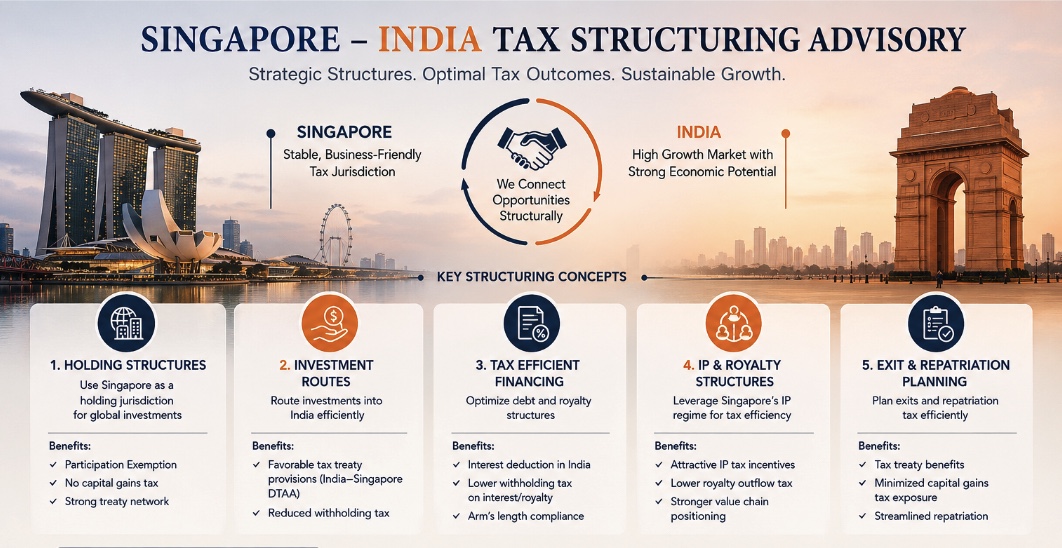
Understanding Singapore – India Tax Structuring
Singapore–India tax structuring refers to the strategic design of a company’s financial, operational, and legal framework to achieve optimal tax efficiency while operating across both jurisdictions. For businesses with cross-border activities, this process goes beyond basic tax planning—it involves aligning corporate structures, revenue flows, and compliance requirements with the tax regulations of both Singapore and India.
At its core, effective tax structuring focuses on minimizing tax exposure without compromising compliance. This includes evaluating how income is generated, where it is taxed, and how profits are distributed between entities. Businesses must also consider factors such as transfer pricing, withholding taxes, and regulatory reporting obligations in both countries.
One of the key components of this structuring is the proper use of the Double Taxation Avoidance Agreement (DTAA) between Singapore and India. The treaty provides mechanisms to prevent the same income from being taxed twice and offers reduced tax rates on certain cross-border payments such as dividends, interest, and royalties. However, accessing these benefits requires careful planning, including meeting substance requirements and establishing clear tax residency.
Companies expanding internationally often face challenges such as overlapping tax rules, evolving regulations, and increased scrutiny from tax authorities. This is where professional guidance becomes essential. Businesses frequently rely on Singapore–India DTAA tax advisory services to navigate these complexities, ensure accurate reporting, and structure transactions efficiently.
Benefits of Cross-Border Tax Optimization
Effective cross border tax planning for Singapore – India transactions provides several advantages:
- Reduced Tax Liability: Optimize tax exposure using treaty benefits and efficient structuring.
- Avoidance of Double Taxation: Prevent income from being taxed in both countries.
- Improved Cash Flow: Better tax planning leads to more retained earnings.
- Regulatory Compliance: Stay aligned with both Singapore and Indian tax laws.
- Efficient Profit Repatriation: Transfer profits between entities with minimal tax leakage.
Cross-border tax optimization is essential for companies with international operations, subsidiaries, or investment flows between Singapore and India.
DTAA Between India and Singapore Explained
The Double Taxation Avoidance Agreement (DTAA) between India and Singapore is designed to ensure that income earned in one country is not taxed twice.
Key highlights include:
- Elimination of Double Taxation: Tax paid in one country can be credited in the other.
- Reduced Withholding Tax Rates: On dividends, interest, and royalties.
- Capital Gains Benefits: Certain exemptions may apply depending on structure and substance.
- Clear Tax Residency Rules: Helps determine which country has taxing rights.
Utilizing the DTAA effectively requires expert Singapore India DTAA tax advisory services to ensure compliance while maximizing benefits.
Singapore vs India Tax Comparison
| Aspect | Singapore | India |
|---|---|---|
| Corporate Tax Rate | 17% (with exemptions) | 22% (domestic companies, concessional) |
| Dividend Tax | No tax on dividends | Taxable in hands of shareholders |
| Capital Gains Tax | Generally not applicable | Applicable depending on asset type |
| Withholding Tax | Lower rates, DTAA benefits apply | Higher rates, reduced via DTAA |
| Ease of Doing Business | Very high | Moderate but improving |
| Regulatory Environment | Stable and business-friendly | More complex compliance framework |
Tax Planning Strategies for Businesses
Businesses operating between India and Singapore can benefit significantly from well-structured and compliant tax strategies. Effective cross border tax planning for companies having presence in Singapore and India not only reduces tax exposure but also supports long-term growth and scalability.
Common Tax Structuring Strategies
| Strategy | Purpose | Benefit |
|---|---|---|
| Holding Company in Singapore | Centralize global operations | Tax efficiency and easier expansion |
| Transfer Pricing Planning | Align intercompany pricing | Compliance + reduced tax risk |
| Profit Repatriation Structuring | Optimize fund movement | Lower withholding taxes |
| Substance Planning | Meet regulatory requirements | Access DTAA benefits |
| Subsidiary Structuring | Organize international entities | Improved compliance and efficiency |
Below are key tax planning strategies:
1. Holding Company Structures
Establishing a Singapore-based holding company is a widely used strategy for Indian businesses expanding globally. It offers tax efficiency, access to international markets, and advantages under the Singapore tax advisory services framework.
2. Transfer Pricing Optimization
Proper transfer pricing ensures that intercompany transactions between Indian and Singapore entities are conducted at arm’s length while minimizing tax liabilities. This is a critical component of compliant cross-border operations.
3. Profit Repatriation Planning
Efficient structuring of dividends, royalties, and management fees helps reduce withholding taxes and enables smooth profit repatriation between jurisdictions. This is where expert Singapore – India DTAA tax advisory services plays a vital role.
4. Substance and Compliance Planning
To fully benefit from tax treaties, businesses must maintain adequate economic substance in Singapore. This includes having local directors, office presence, and genuine business activity to meet regulatory requirements.
5. Foreign Subsidiary Structuring
Optimizing the structure of overseas entities ensures tax efficiency and regulatory compliance. Professional Singapore tax advisory for foreignsubsidiaries helps businesses design structures that align with both Indian and Singapore tax laws.
A qualified Singapore tax structuring consultant for Indian companies can customize these strategies based on your business model, industry, and expansion plans, ensuring maximum tax efficiency with full compliance.
Case Study
Case Study 1
Scenario
An Indian technology company planned to expand into Southeast Asia and set up a Singapore entity for global operations.
Challenge
The company faced high tax exposure due to inefficient structuring and unclear profit allocation between India and Singapore.
Solution
AnBac Advisors implemented a strategic tax structure:
- Established a Singapore holding entity
- Optimized transfer pricing policies
- Leveraged DTAA benefits for reduced withholding taxes
- Structured revenue streams for tax efficiency
Result
- Reduced overall tax leakages by over 25%
- Improved cash flow and reinvestment capacity
- Achieved full compliance with both jurisdictions
- Enabled smooth international expansion
This case highlights the importance of working with a qualified Singapore tax structuring consultant for Indian companies.
Case Study 2
Scenario
A Singapore-based e-commerce company expanded into India by setting up a wholly owned subsidiary to tap into the growing Indian market. The business required efficient structuring to manage cross-border transactions and optimize tax exposure.
Challenge
The company faced multiple challenges, including:
- High withholding taxes on cross-border payments
- Complex GST and corporate tax compliance in India
- Inefficient profit repatriation structure
- Risk of double taxation due to improper planning
Solution
AnBac Advisors provided comprehensive cross border tax planning solutions:
- Structured the Indian subsidiary to align with regulatory and tax requirements
- Implemented tax-efficient intercompany agreements for services and royalties
- Optimized transfer pricing policies in line with Indian regulations
- Leveraged Singapore India DTAA tax advisory services to reduce withholding tax burden
- Designed a compliant profit repatriation strategy
Result
- Reduced withholding tax impact significantly
- Ensured full compliance with Indian and Singapore tax laws
- Streamlined profit repatriation with minimal tax leakage
- Improved overall operational and tax efficiency
This case demonstrates how expert Singapore tax advisory for foreign subsidiariescan drive efficient cross-border expansion.
Common Mistakes in Singapore–India Tax Structuring
p>Even well-established businesses often make critical errors when planning cross-border structures between Singapore and India. Avoiding these mistakes is essential to ensure tax efficiency, compliance, and long-term sustainability.
1. Over-Reliance on Tax Benefits Without Substance
Many companies set up Singapore entities purely to access tax benefits under the DTAA, without establishing real business presence. This can lead to denial of treaty benefits and increased scrutiny from tax authorities.
2. Ignoring Transfer Pricing Regulations
Improper pricing of intercompany transactions is one of the most common issues in cross-border operations. Non-compliance with transfer pricing rules can result in penalties, audits, and tax adjustments in both jurisdictions.
3. Inefficient Profit Repatriation Structures
Failing to plan how profits will be distributed—whether through dividends, royalties, or service fees—can lead to higher withholding taxes and reduced overall returns.
4. Lack of Alignment Between Business and Tax Structure
A structure that does not reflect actual business operations (such as decision-making or revenue generation) may be challenged by tax authorities, especially under evolving global compliance standards.
5. Not Leveraging the DTAA Effectively
While the Singapore–India DTAA offers significant benefits, many businesses either underutilize or incorrectly apply its provisions due to lack of proper advisory.
6. Delayed or Reactive Tax Planning
Waiting until after expansion to address tax structuring often leads to costly restructuring, compliance risks, and missed optimization opportunities.
Strategic and Future-Ready Approach to Cross-Border Tax Structuring
- Unlike traditional tax planning that focuses only on short-term savings, effective Singapore–India tax structuring requires a forward-looking approach that aligns with evolving global regulations such as BEPS (Base Erosion and Profit Shifting) and increasing scrutiny on substance and transparency.
- Businesses today must design structures that are not only tax-efficient but also resilient to regulatory changes and scalable for future expansion. This means going beyond standard holding company setups and carefully evaluating where real decision-making, value creation, and operational control reside.
- A well-designed structure anticipates future audits, supports seamless capital movement, and adapts to changing business models—whether it’s digital services, cross-border investments, or regional headquarters expansion. Companies that adopt this strategic approach are better positioned to avoid restructuring costs later, maintain credibility with tax authorities, and build a sustainable international presence.
Why Choose AnBac Advisors ?
AnBac Advisors provides specialized expertise in Singapore–India tax structuring with a focus on compliance, efficiency, and long-term growth.
- Deep understanding of both Singapore and Indian tax systems
- Customized solutions for Large enterprises, Startups and SMEs
- Strong focus on regulatory compliance and risk mitigation
- End-to-end advisory from structuring to implementation
- Proven experience in cross border tax planning for Singapore – India transactions
FAQs
1. What are the benefits of Singapore for Indian businesses expanding globally?
Singapore offers a favorable tax regime, a strong legal framework, and excellent access to global markets, making it an ideal hub for Indian companies planning international expansion.
2. How do Singapore – India DTAA tax advisory services help avoid double taxation?
The Double Taxation Avoidance Agreement (DTAA) allows taxes paid in one country to be credited against tax payable in the other, ensuring businesses are not taxed twice on the same income.
3. Why is cross border tax planning for Singapore – India important for businesses?
Effective cross-border tax planning helps reduce tax liabilities, ensures regulatory compliance, and improves overall financial efficiency for businesses operating between India and Singapore.
4. Do I need a tax structuring consultant to manage Singapore subsidiary business for Indian companies?
Yes, a professional tax structuring consultant having expertise in both – Singapore laws and regulations for Indian companies, can help design compliant and tax-efficient structures tailored to your business model and expansion strategy.
5. What does Singapore tax advisory for foreign subsidiaries include?
Singapore tax advisory for foreign subsidiaries typically includes company structuring, DTAA advisory, transfer pricing, compliance planning, and ongoing tax support.
6. Is Singapore–India tax structuring legal and compliant?
Yes, tax structuring is completely legal when done in accordance with the applicable tax laws and regulations of both Singapore and India.
By leveraging expert Singapore tax advisory for foreign subsidiaries and tailored strategies, businesses can achieve efficient, compliant, and scalable cross-border operations between India and Singapore.