 IND
IND AUS
AUS UAE
UAE USA
USA
Financial Due Diligence for Singapore companies
– M&A, Fundraising, Family Offices, Venture Funds, IPOs
Role of Financial Due Diligence in M&A and Decision-Making
In today’s competitive transaction environment, Financial Due Diligence (FDD) has evolved from a routine validation exercise into a critical decision-making tool for investors, private equity funds, and corporates.
In the context of financial due diligence services in Singapore for M&A, investment transactions, and fundraising, stakeholders often seek clarity and need an investigative lens to assess the opportunity.
Whether engaging a due diligence consultant in Singapore for acquisitions or working with a buy-side due diligence firm in Singapore, the objective remains consistent – to validate financial performance, identify risks, and support informed transaction decisions.
At the senior decision-making level, stakeholders are focused on answering key questions:
- Are the reported earnings sustainable?
- What risks are embedded in the financials?
- Is the valuation justified?
- What could go wrong post-transaction?
- How to reduce overall risk exposure?
Financial due diligence bridges the gap between reported financial performance and actual economic reality, enabling stakeholders to make informed, risk-adjusted decisions.
It becomes particularly critical at inflection points involving capital deployment, ownership change, or strategic restructuring, where even minor financial misstatements can result in significant financial and reputational impact.
Key Transaction Scenarios Requiring Financial Due Diligence
Financial due diligence is not a one-size-fits-all exercise. It becomes essential across multiple transaction scenarios where financial clarity directly impacts decision-making. Identify financial risks, validate earnings quality, and make informed transaction decisions with expert-led financial due diligence.
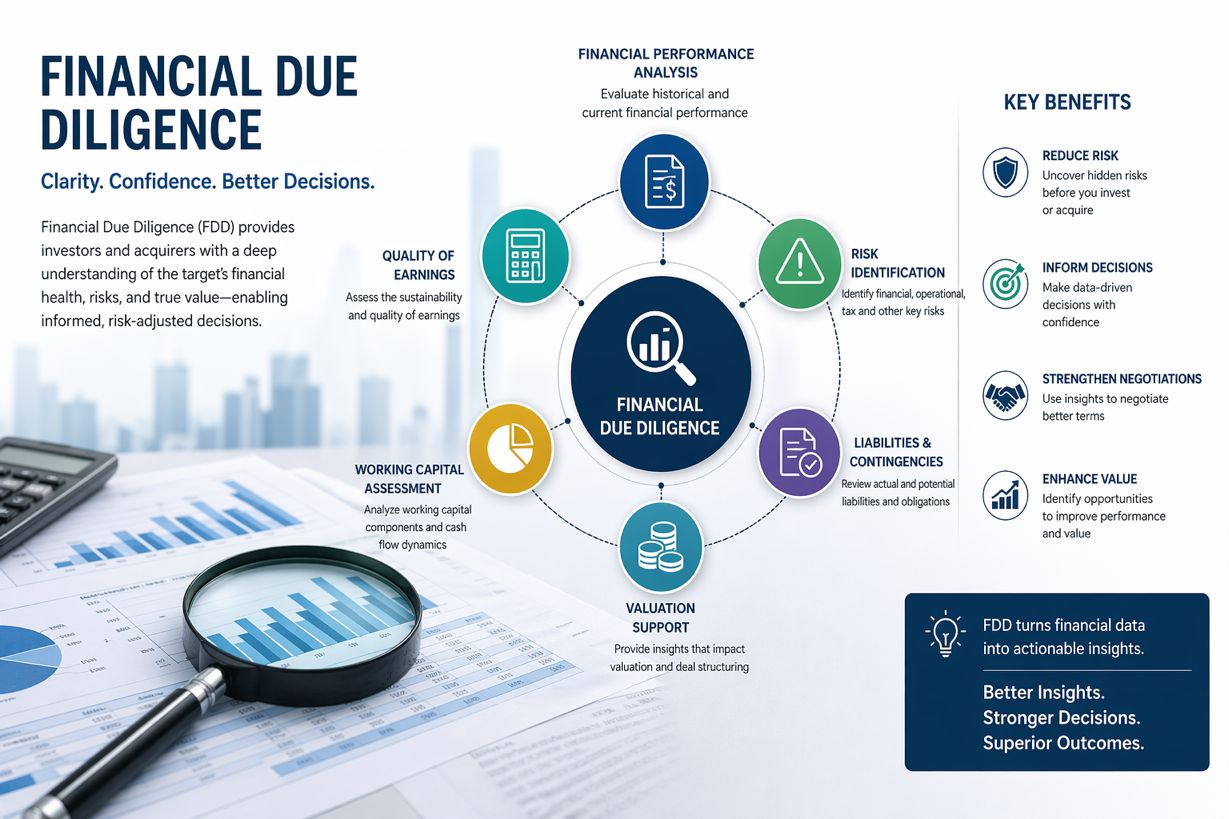
- Mergers & Acquisitions (M&A)
In M&A transactions, financial due diligence plays a central role in evaluating the true financial health of the target business.
Key focus areas include:
- Quality of earnings (QoE)
- Revenue sustainability
- Working capital requirements
- Debt and contingent liabilities
- Asset quality checks
Without robust financial due diligence:
- Buyers risk overpaying for inflated earnings
- Undisclosed liabilities may emerge post-acquisition
- Integration challenges increase significantly
Strategic Insight:
In M&A, financial due diligence does not just validate numbers – it directly influences deal valuation, negotiation strategy, and transaction structuring.
- Fundraising (Private Equity / Venture Capital)
For companies seeking capital, financial due diligence acts as a credibility filter for investors.
Investors rely on FDD to validate:
- Revenue quality and repeatability
- Margin sustainability
- Financial discipline and controls
Without proper diligence:
- Valuation may be significantly discounted
- Investors may delay or withdraw
- Confidence in management weakens
Key Point:
Financial due diligence transforms founder-driven narratives into investor-grade financial validation.
- Investment Decisions (Buy-Side Due Diligence)
For investors, FDD is a critical component of the investment decision process.
It answers fundamental questions:
- Is EBITDA reflective of true profitability?
- Are cash flows sustainable?
- What risks could impact returns?
Financial due diligence enables investors to move from assumptions to data-backed investment decisions.
- NAV Calculation (Funds and Holding Structures)
For funds and investment vehicles, accurate Net Asset Value (NAV) calculation depends on reliable financial reporting.
Errors in financials can lead to:
- Overvaluation of portfolio companies
- Investor disputes
- Regulatory scrutiny
Financial due diligence ensures that valuations are grounded in financial reality rather than assumptions.
- Partnerships and Co-founder Additions
When new stakeholders are introduced into a business, financial transparency becomes essential.
Without financial due diligence:
- Profit-sharing disputes may arise
- Misaligned expectations can lead to conflicts
- Legal exposure increases
FDD ensures alignment by establishing a clear financial baseline for all parties.
- Share Swap and Intellectual Property Transactions
In transactions involving equity swaps or intellectual property transfers, valuation is often based on financial assumptions.
Without due diligence:
- Shares may be mispriced
- Intellectual property may be overvalued
- Long-term financial imbalance may occur
Financial due diligence requirements vary significantly depending on the transaction context—whether it is acquisition, fundraising, or investment evaluation.
Comparison: Financial Due Diligence Across Transaction Scenarios
| Aspect | M&A (Buy-Side / Acquisition) | Fundraising (Sell-Side / Company) | Investment Decisions (Investor-Led) |
|---|---|---|---|
| Primary Objective | Identify risks and validate valuation before acquisition | Prepare investor-ready financials and defend valuation | Evaluate risk-return profile before deploying capital |
| Who Drives the Process | Buyer / Acquirer | Company / Founders | Investor / PE / Fund |
| Core Focus | Quality of earnings, liabilities, working capital, deal risks | Financial story alignment, data readiness, credibility | Investment thesis validation, returns, downside risk |
| Key Question Answered | “Am I overpaying and what risks am I acquiring?” | “Will investors trust my numbers and valuation?” | “Will I achieve expected returns and what is my downside?” |
| Nature of Review | Investigative and risk-focused | Pre-emptive and positioning-driven | Analytical and decision-driven |
| Revenue Analysis | Sustainability, concentration, recognition policies | Alignment with growth narrative and projections | Stability and impact on future returns |
| Earnings Analysis (QoE) | Normalize EBITDA and identify adjustments | Ensure consistency with investor expectations | Validate profitability and sustainability |
| Risk Identification | Hidden liabilities, tax exposure, financial inconsistencies | Pre-emptive identification of red flags | Downside risk, sensitivity analysis |
| Working Capital Focus | Normalize working capital for deal pricing | Ensure liquidity presentation is accurate | Assess cash flow sufficiency and funding needs |
| Outcome on Deal | Impacts valuation, deal structure, and negotiations | Impacts valuation, investor confidence, and speed of closure | Impacts investment decision, pricing, and structuring |
| Typical Result | Price renegotiation / deal restructuring | Faster fundraising / improved valuation | Go / No-Go decision or revised investment terms |
| Time of Execution | During transaction (pre-acquisition) | Before investor engagement | Before capital deployment |
| Strategic Impact | Protects against overpayment and post-deal surprises | Strengthens positioning and reduces investor objections | Ensures informed, risk-adjusted investment decisions |
Risks of Neglecting Financial Due Diligence
This is the most critical aspect of financial due diligence – understanding what can go wrong in its absence.
- Fraud Risk
- Inflated revenues
- Fictitious customers
- Manipulated accounts
Impact:
- Direct financial loss
- Legal consequences
- Reputational damage
- Misstated Financials (Investment Risk)
- EBITDA inflated through aggressive adjustments
- One-time income treated as recurring revenue
Impact:
- Overvaluation
- Reduced return on investment
- Post-Transaction Tax and Liability Exposure
- Undisclosed tax liabilities
- Non-compliance with regulations
Impact:
- Unexpected tax demands
- Post-deal financial stress
- NAV Misstatement
- Overstatement of revenue or assets
Impact:
- Inflated fund valuation
- Investor disputes
- Partnership and Co-founder Disputes
- Lack of financial clarity
- Hidden liabilities
Impact:
- Legal disputes
- Business disruption
Financial due diligence is not about validating numbers—it is about identifying what can go wrong after the transaction closes.
Financial Due Diligence in M&A Transactions
In M&A, financial due diligence is a deal-shaping exercise, not a compliance checklist.
It directly impacts:
- Valuation
- Negotiation leverage
- Deal structure
- Risk allocation
Key Areas of Analysis
- Quality of Earnings (QoE)
- Normalize EBITDA
- Identify non-recurring items
- Assess true profitability
- Revenue Analysis
- Customer concentration
- Revenue recognition policies
- Sustainability of income streams
- Working Capital Normalization
- Identify true operating requirements
- Prevent post-deal cash flow shocks
- Debt and Liability Assessment
- Off-balance sheet items
- Contingent liabilities
- Tax exposures
Deal Impact
FDD findings often result in:
- Price renegotiation
- Earn-out structures
- Changes in deal terms
- In some cases, deal termination
Financial Due Diligence for Investment Decisions (Buy-Side)
In investment scenarios, financial due diligence is investor-driven and risk-focused, aimed at validating whether the investment thesis holds under detailed financial scrutiny.
Unlike fundraising, where the company prepares for diligence, here the investor uses FDD to challenge assumptions and uncover risks.
What Makes Investment FDD Different?
- Independent and objective
- Focused on downside protection
- Designed to validate return potential
Key Focus Areas
- Investment Thesis Validation
- Does financial performance support the growth story?
- Are projections realistic?
Converts assumptions into data-backed insights
- Return Sensitivity Analysis
- Impact of revenue/margin changes on returns
- Stress-testing financial performance
Helps investors understand best-case vs worst-case outcomes
- Risk vs Return Alignment
- Identifying financial and operational risks
- Evaluating whether returns justify the risk
Critical for capital allocation decisions
- Cash Flow and Exit Visibility
- Ability to generate cash
- Potential for exit (IPO / strategic sale)
Ensures investment is liquid and scalable
Strategic Outcome
- Informed investment decisions
- Better deal structuring
- Reduced downside risk
Financial Due Diligence for Fundraising (Sell-Side)
In fundraising scenarios, financial due diligence is pre-emptive and positioning-driven, unlike M&A where it is investigative.
The objective is not just to validate financials, but to ensure that the company presents investor-ready, defensible financial information before entering discussions with private equity or venture capital investors.
What Makes Fundraising FDD Different?
Unlike M&A, where diligence is driven by the buyer, fundraising due diligence is:
- Founder-initiated
- Focused on minimizing investor objections
- Designed to protect valuation and speed up closure
Key Focus Areas
- Financial Story Alignment
- Aligning financials with the growth narrative
- Eliminating inconsistencies between pitch deck and actual numbers
Investors often reject deals due to story vs numbers mismatch
- Pre-emptive Risk Identification
- Identifying red flags before investor discovery
- Addressing issues proactively
Prevents last-minute valuation cuts
- Data Room Readiness
- Structuring financial data for investor review
- Ensuring clarity, consistency, and completeness
Speeds up investor due diligence significantly
Strategic Outcome
- Stronger investor confidence
- Faster deal execution
- Better valuation outcomes
Anbac Advisors Approach to Financial Due Diligence
At Anbac Advisors, we approach financial due diligence as a strategic advisory function, not just a reporting exercise.
Our Approach
- Quality of Earnings Deep Dive
We assess whether reported earnings reflect true operational performance by:
- Removing non-recurring items
- Identifying aggressive accounting
- Normalizing profitability
- Revenue Validation
We analyze:
- Revenue streams
- Customer contracts
- Sustainability of earnings
- Working Capital Analysis
We determine:
- Normalized working capital levels
- Cash flow implications for deal structuring
- Risk Identification
We identify:
- Hidden liabilities
- Tax exposures
- Financial inconsistencies
- Deal Advisory Support
We go beyond reporting to:
- Quantify financial risks
- Support valuation discussions
- Assist in negotiation strategy
Why Anbac Advisors ?
- Focus on decision-relevant insights, not just data
- Strong experience across M&A, fundraising, and investments
- Emphasis on risk identification and deal impact
Frequently Asked Questions (FAQs)
(i) When is financial due diligence critical?
Financial due diligence becomes critical in any transaction involving capital deployment, ownership change, or valuation assessment – particularly in mergers and acquisitions (M&A), fundraising, and strategic investments.
In Singapore, companies and investors typically engage financial due diligence services for M&A transactions to validate financial performance, assess risks, and support deal negotiations. Whether it is a full acquisition or minority investment, early-stage diligence helps avoid costly surprises post-transaction.
(ii) What are the biggest risks identified during financial due diligence?
Financial due diligence is designed to uncover risks that are not immediately visible in reported financials. These include:
- Revenue misstatements and aggressive recognition practices
- Hidden or contingent liabilities
- Tax exposures and compliance gaps
- Weak cash flow generation
- Inconsistent or unreliable financial reporting
An experienced due diligence consultant in Singapore for acquisitions focuses on identifying these risks early, enabling investors and acquirers to make informed, risk-adjusted decisions.
(iii) How does financial due diligence impact valuation?
Financial due diligence has a direct impact on transaction valuation by assessing the quality and sustainability of earnings.
Through detailed analysis – often referred to as M&A financial audit and advisory in Singapore – key adjustments are made to:
- Normalize EBITDA
- Remove non-recurring income or expenses
- Identify financial risks impacting future performance
These findings influence deal pricing, negotiation leverage, and transaction structuring, often leading to valuation adjustments or revised deal terms.
(iv) Can financial due diligence prevent deal failure?
Yes. Financial due diligence plays a critical role in preventing deal failure or post-deal financial distress.
By identifying risks early, stakeholders can:
- Renegotiate deal terms
- Introduce protective mechanisms (earn-outs, indemnities)
- Exit high-risk transactions
Leading buy-side due diligence firms in Singaporeuse this process to ensure that investment decisions are backed by verified financial insights rather than assumptions.
(v) Why do investors insist on financial due diligence?
Investors rely on financial due diligence to independently verify financial performance and assess whether the investment aligns with their return expectations.
Unaudited or unverified financials do not provide sufficient assurance for capital allocation decisions. As a result, investors engage specialized financial due diligence services in Singapore for M&A and investmentsto evaluate:
- Profitability sustainability
- Cash flow strength
- Risk exposure
This ensures that investment decisions are based on credible financial data and a clear understanding of downside risks.
Conclusion
Financial due diligence has become a critical component of strategic transactions, enabling stakeholders to evaluate risks, validate financial assumptions, and make informed decisions.
In an environment where capital allocation decisions carry significant financial implications, a well-executed financial due diligence process ensures:
- Risk mitigation
- Informed decision-making
- Successful transaction outcomes